



Close Menu
UK Daily: Tech, Science, Business & Lifestyle News UpdatesUK Daily: Tech, Science, Business & Lifestyle News Updates
    What's Hot

    Stablecoin Market Tops $313 Billion as Sky’s USDS Leads Weekly Gains

    March 7, 2026

    Teenage boy on bike is injured in Worthing collision

    March 7, 2026

    World-Class Competition BBQ Returns to Grand Junction for the Inaugural Rocky Mountain BBQ Classic

    March 7, 2026
    Facebook X (Twitter) Instagram
    Trending
    • Stablecoin Market Tops $313 Billion as Sky’s USDS Leads Weekly Gains
    • Teenage boy on bike is injured in Worthing collision
    • World-Class Competition BBQ Returns to Grand Junction for the Inaugural Rocky Mountain BBQ Classic
    • Navigating The Hidden Dangers Of USB Devices In The Modern Workspace
    • PopSockets founder David Barnett talks about building a viral business
    • Monzo slammed for ‘shaming’ end of year reviews
    • Driver charged after East Renfrewshire crash as car hit wall
    • Former Irish President condemns US ‘attacks on truth’ at Belfast Women’s Day rally
    • London
    • Kent
    • Glasgow
    • Cardiff
    • Belfast
    Facebook X (Twitter) Instagram YouTube
    UK Daily: Tech, Science, Business & Lifestyle News UpdatesUK Daily: Tech, Science, Business & Lifestyle News Updates
    Subscribe
    Saturday, March 7
    • Home
    • News
      1. Kent
      2. London
      3. Belfast
      4. Birmingham
      5. Cardiff
      6. Edinburgh
      7. Glasgow
      8. Liverpool
      9. Manchester
      10. Newcastle
      11. Nottingham
      12. Sheffield
      13. West Yorkshire
      Featured

      ‘Miniature’ mountain creature with ‘squeaker’-like call discovered as new species

      Science November 9, 2023
      Recent

      Stablecoin Market Tops $313 Billion as Sky’s USDS Leads Weekly Gains

      March 7, 2026

      Teenage boy on bike is injured in Worthing collision

      March 7, 2026

      Navigating The Hidden Dangers Of USB Devices In The Modern Workspace

      March 7, 2026
    • Lifestyle
      1. Celebrity
      2. Fashion
      3. Food
      4. Leisure
      5. Social Good
      6. Trending
      7. Wellness
      8. Event
      Featured

      How Did She Die? – Hollywood Life

      Celebrity March 7, 2026
      Recent

      How Did She Die? – Hollywood Life

      March 7, 2026

      The Risks to Be Aware of – Hollywood Life

      March 7, 2026

      What Happened to Stephanie Buttermore? About Jeff Nippard’s Fiancee – Hollywood Life

      March 7, 2026
    • Science
    • Business
    • Sports

      League Two match report from Priestfield Stadium

      March 7, 2026

      Live updates from Gillingham v Fleetwood Town, Ebbsfleet United v Torquay United, Maidenhead United v Maidstone United, Folkestone Invicta v Potters Bar Town

      March 7, 2026

      Friday March 6 to Wednesday March 11

      March 6, 2026

      Gillingham manager Gareth Ainsworth looks ahead to Fleetwood Town’s visit to Priestfield and a busy run of home games

      March 6, 2026

      Football League clubs approve expansion of Championship play-offs from next season – Gillingham boss Gareth Ainsworth has his say

      March 6, 2026
    • Politics
    • Tech
    • Property
    • Press Release
    UK Daily: Tech, Science, Business & Lifestyle News UpdatesUK Daily: Tech, Science, Business & Lifestyle News Updates
    Home » New technique helps robots pack objects into a tight space | MIT News

    New technique helps robots pack objects into a tight space | MIT News

    bibhutiBy bibhutiNovember 19, 2023 Tech No Comments7 Mins Read
    Facebook Twitter LinkedIn WhatsApp Telegram
    Share
    Facebook Twitter LinkedIn Telegram WhatsApp


    Anyone who has ever tried to pack a family-sized amount of luggage into a sedan-sized trunk knows this is a hard problem. Robots struggle with dense packing tasks, too.

    For the robot, solving the packing problem involves satisfying many constraints, such as stacking luggage so suitcases don’t topple out of the trunk, heavy objects aren’t placed on top of lighter ones, and collisions between the robotic arm and the car’s bumper are avoided.

    Some traditional methods tackle this problem sequentially, guessing a partial solution that meets one constraint at a time and then checking to see if any other constraints were violated. With a long sequence of actions to take, and a pile of luggage to pack, this process can be impractically time consuming.   

    MIT researchers used a form of generative AI, called a diffusion model, to solve this problem more efficiently. Their method uses a collection of machine-learning models, each of which is trained to represent one specific type of constraint. These models are combined to generate global solutions to the packing problem, taking into account all constraints at once.

    Their method was able to generate effective solutions faster than other techniques, and it produced a greater number of successful solutions in the same amount of time. Importantly, their technique was also able to solve problems with novel combinations of constraints and larger numbers of objects, that the models did not see during training.

    Due to this generalizability, their technique can be used to teach robots how to understand and meet the overall constraints of packing problems, such as the importance of avoiding collisions or a desire for one object to be next to another object. Robots trained in this way could be applied to a wide array of complex tasks in diverse environments, from order fulfillment in a warehouse to organizing a bookshelf in someone’s home.

    “My vision is to push robots to do more complicated tasks that have many geometric constraints and more continuous decisions that need to be made — these are the kinds of problems service robots face in our unstructured and diverse human environments. With the powerful tool of compositional diffusion models, we can now solve these more complex problems and get great generalization results,” says Zhutian Yang, an electrical engineering and computer science graduate student and lead author of a paper on this new machine-learning technique.

    Her co-authors include MIT graduate students Jiayuan Mao and Yilun Du; Jiajun Wu, an assistant professor of computer science at Stanford University; Joshua B. Tenenbaum, a professor in MIT’s Department of Brain and Cognitive Sciences and a member of the Computer Science and Artificial Intelligence Laboratory (CSAIL); Tomás Lozano-Pérez, an MIT professor of computer science and engineering and a member of CSAIL; and senior author Leslie Kaelbling, the Panasonic Professor of Computer Science and Engineering at MIT and a member of CSAIL. The research will be presented at the Conference on Robot Learning.

    Constraint complications

    Continuous constraint satisfaction problems are particularly challenging for robots. These problems appear in multistep robot manipulation tasks, like packing items into a box or setting a dinner table. They often involve achieving a number of constraints, including geometric constraints, such as avoiding collisions between the robot arm and the environment; physical constraints, such as stacking objects so they are stable; and qualitative constraints, such as placing a spoon to the right of a knife.

    There may be many constraints, and they vary across problems and environments depending on the geometry of objects and human-specified requirements.

    To solve these problems efficiently, the MIT researchers developed a machine-learning technique called Diffusion-CCSP. Diffusion models learn to generate new data samples that resemble samples in a training dataset by iteratively refining their output.

    To do this, diffusion models learn a procedure for making small improvements to a potential solution. Then, to solve a problem, they start with a random, very bad solution and then gradually improve it.
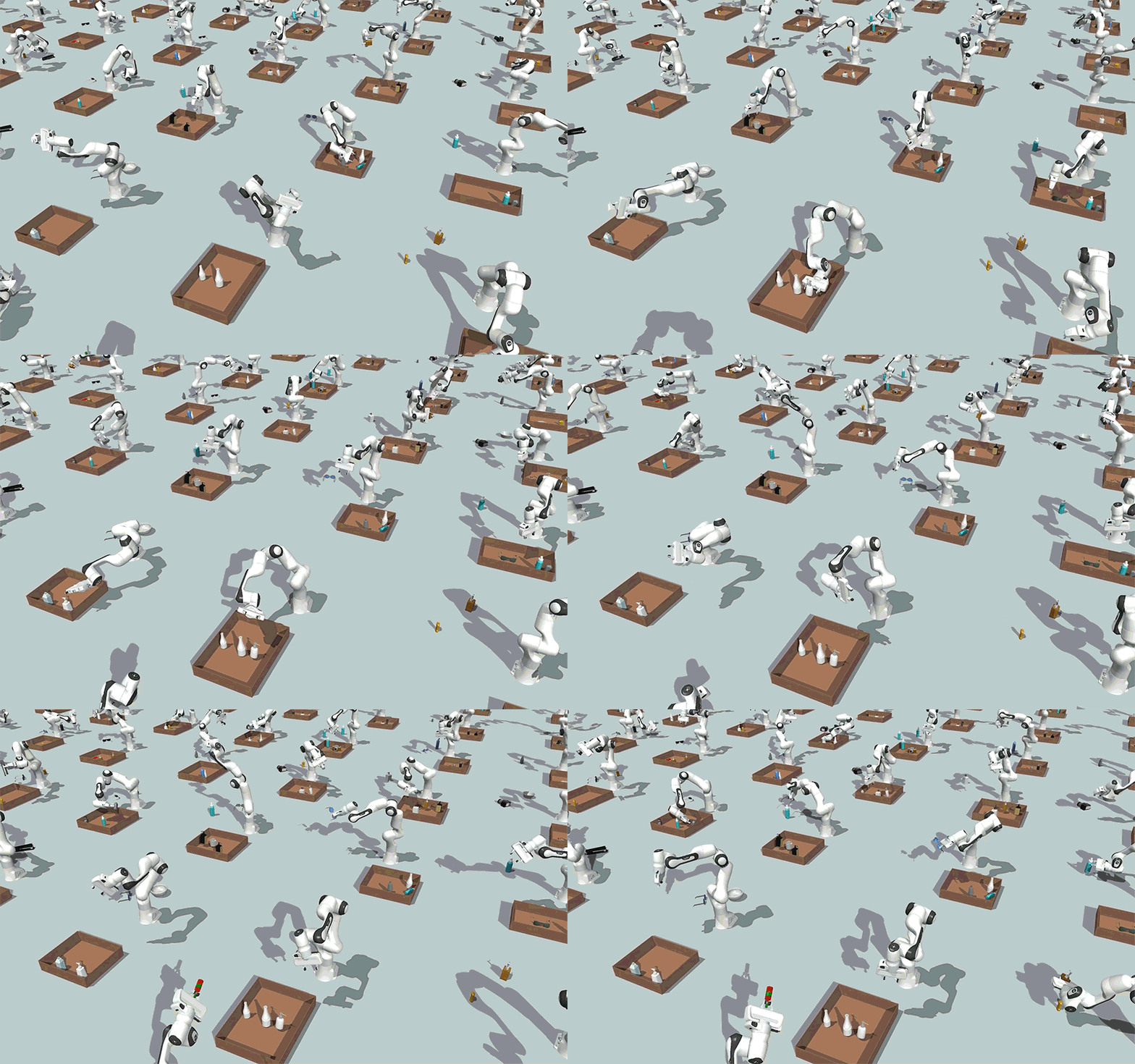
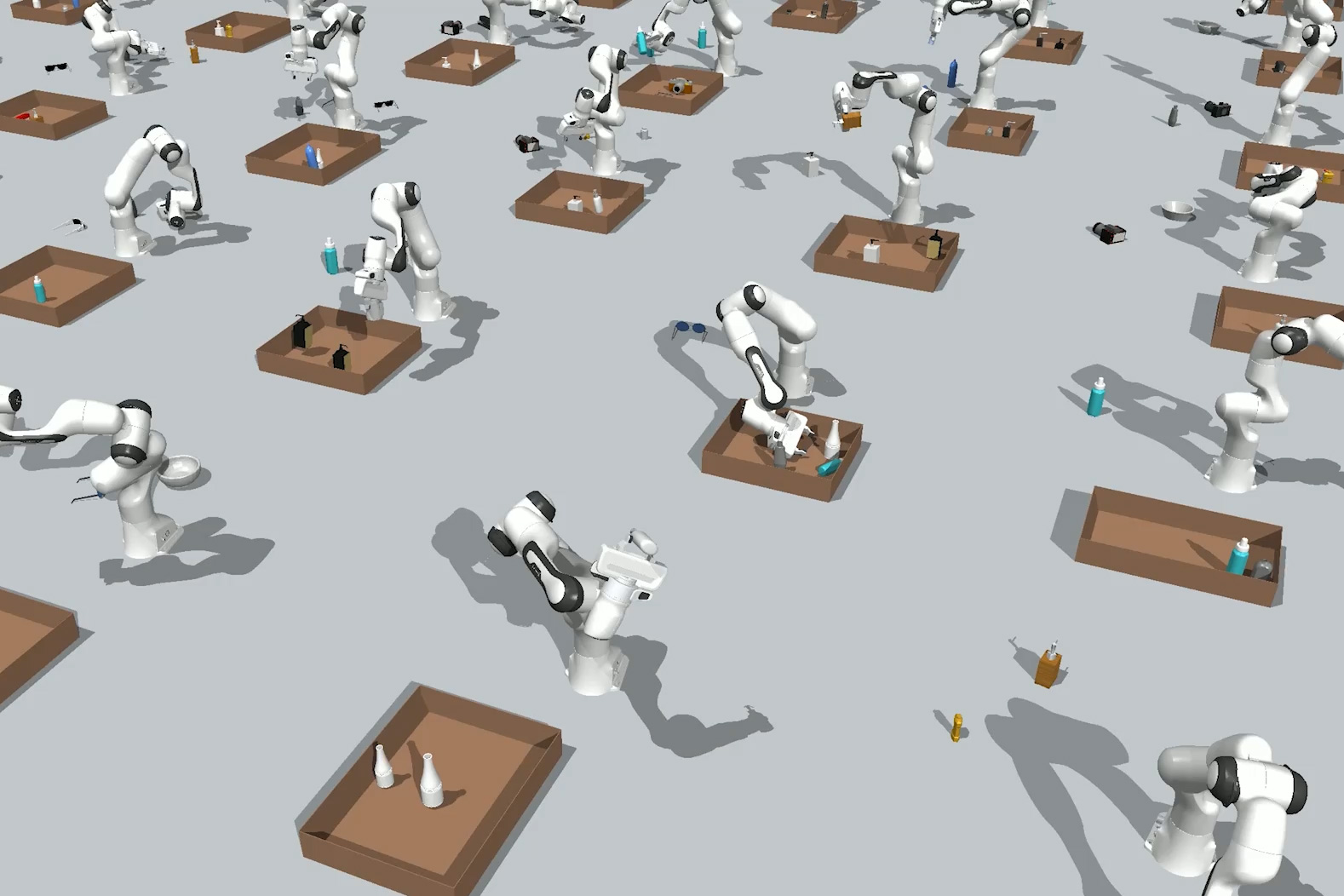
    Animation of grid of robot arms with a box in front of each one. Each robot arm is grabbing objects nearby, like sunglasses and plastic containers, and putting them inside a box.
    Using generative AI models, MIT researchers created a technique that could enable robots to efficiently solve continuous constraint satisfaction problems, such as packing objects into a box while avoiding collisions, as shown in this simulation.

    Image: Courtesy of the researchers

    For example, imagine randomly placing plates and utensils on a simulated table, allowing them to physically overlap. The collision-free constraints between objects will result in them nudging each other away, while qualitative constraints will drag the plate to the center, align the salad fork and dinner fork, etc.

    Diffusion models are well-suited for this kind of continuous constraint-satisfaction problem because the influences from multiple models on the pose of one object can be composed to encourage the satisfaction of all constraints, Yang explains. By starting from a random initial guess each time, the models can obtain a diverse set of good solutions.

    Working together

    For Diffusion-CCSP, the researchers wanted to capture the interconnectedness of the constraints. In packing for instance, one constraint might require a certain object to be next to another object, while a second constraint might specify where one of those objects must be located.

    Diffusion-CCSP learns a family of diffusion models, with one for each type of constraint. The models are trained together, so they share some knowledge, like the geometry of the objects to be packed.

    The models then work together to find solutions, in this case locations for the objects to be placed, that jointly satisfy the constraints.

    “We don’t always get to a solution at the first guess. But when you keep refining the solution and some violation happens, it should lead you to a better solution. You get guidance from getting something wrong,” she says.

    Training individual models for each constraint type and then combining them to make predictions greatly reduces the amount of training data required, compared to other approaches.

    However, training these models still requires a large amount of data that demonstrate solved problems. Humans would need to solve each problem with traditional slow methods, making the cost to generate such data prohibitive, Yang says.

    Instead, the researchers reversed the process by coming up with solutions first. They used fast algorithms to generate segmented boxes and fit a diverse set of 3D objects into each segment, ensuring tight packing, stable poses, and collision-free solutions.

    “With this process, data generation is almost instantaneous in simulation. We can generate tens of thousands of environments where we know the problems are solvable,” she says.

    Trained using these data, the diffusion models work together to determine locations objects should be placed by the robotic gripper that achieve the packing task while meeting all of the constraints.

    They conducted feasibility studies, and then demonstrated Diffusion-CCSP with a real robot solving a number of difficult problems, including fitting 2D triangles into a box, packing 2D shapes with spatial relationship constraints, stacking 3D objects with stability constraints, and packing 3D objects with a robotic arm.

    Their method outperformed other techniques in many experiments, generating a greater number of effective solutions that were both stable and collision-free.

    In the future, Yang and her collaborators want to test Diffusion-CCSP in more complicated situations, such as with robots that can move around a room. They also want to enable Diffusion-CCSP to tackle problems in different domains without the need to be retrained on new data.

    “Diffusion-CCSP is a machine-learning solution that builds on existing powerful generative models,” says Danfei Xu, an assistant professor in the School of Interactive Computing at the Georgia Institute of Technology and a Research Scientist at NVIDIA AI, who was not involved with this work. “It can quickly generate solutions that simultaneously satisfy multiple constraints by composing known individual constraint models. Although it’s still in the early phases of development, the ongoing advancements in this approach hold the promise of enabling more efficient, safe, and reliable autonomous systems in various applications.”

    This research was funded, in part, by the National Science Foundation, the Air Force Office of Scientific Research, the Office of Naval Research, the MIT-IBM Watson AI Lab, the MIT Quest for Intelligence, the Center for Brains, Minds, and Machines, Boston Dynamics Artificial Intelligence Institute, the Stanford Institute for Human-Centered Artificial Intelligence, Analog Devices, JPMorgan Chase and Co., and Salesforce.


    Source link

    Featured Just In Top News
    Share. Facebook Twitter LinkedIn Email
    Previous ArticleAWS announces Emerging Technologies Accelerator cohort
    Next Article Did Ashlyn Harris Cheat on Ali Krieger? Statement Amid Divorce – Hollywood Life
    bibhuti
    • Website

    Keep Reading

    Teenage boy on bike is injured in Worthing collision

    PopSockets founder David Barnett talks about building a viral business

    Monzo slammed for ‘shaming’ end of year reviews

    Driver charged after East Renfrewshire crash as car hit wall

    Former Irish President condemns US ‘attacks on truth’ at Belfast Women’s Day rally

    ARMD Solicitations

    Add A Comment
    Leave A Reply Cancel Reply

    Editors Picks

    89th Utkala Dibasa Celebration Brings Odisha’s Vibrant Culture to London

    April 8, 2024

    US and EU pledge to foster connections to enhance research on AI safety and risk.

    April 5, 2024

    Holi Celebrations Across Various Locations in Kent Attract a Diverse Range of Community Participation

    March 25, 2024

    Plans for new Bromley tower blocks up to 14-storeys tall refused

    December 4, 2023
    Latest Posts

    Subscribe to News

    Get the latest sports news from NewsSite about world, sports and politics.

    Advertisement

    Recent Posts

    • Stablecoin Market Tops $313 Billion as Sky’s USDS Leads Weekly Gains
    • Teenage boy on bike is injured in Worthing collision
    • World-Class Competition BBQ Returns to Grand Junction for the Inaugural Rocky Mountain BBQ Classic
    • Navigating The Hidden Dangers Of USB Devices In The Modern Workspace
    • PopSockets founder David Barnett talks about building a viral business

    Recent Comments

    1. Register on Anycubic users say their 3D printers were hacked to warn of a security flaw
    2. Pembuatan Akun Binance on Braiins Becomes First Mining Pool To Introduce Lightning Payouts
    3. tadalafil tablets sale on The market is forcing cloud vendors to relax data egress fees
    4. cerebrozen reviews on Kent director of cricket Simon Cook adapting to his new role during the close season
    5. Glycogen Review on The little-known town just 5 miles from Kent border with stunning beaches and only 600 residents
    The News Times Logo
    Facebook X (Twitter) Pinterest Vimeo WhatsApp TikTok Instagram

    News

    • UK News
    • US Politics
    • EU Politics
    • Business
    • Opinions
    • Connections
    • Science

    Company

    • Information
    • Advertising
    • Classified Ads
    • Contact Info
    • Do Not Sell Data
    • GDPR Policy
    • Media Kits

    Services

    • Subscriptions
    • Customer Support
    • Bulk Packages
    • Newsletters
    • Sponsored News
    • Work With Us

    Subscribe to Updates

    Get the latest creative news from FooBar about art, design and business.

    © 2026 The News Times. Designed by The News Times.
    • Privacy Policy
    • Terms
    • Accessibility

    Type above and press Enter to search. Press Esc to cancel.

    Manage Cookie Consent
    To provide the best experiences, we use technologies like cookies to store and/or access device information. Consenting to these technologies will allow us to process data such as browsing behavior or unique IDs on this site. Not consenting or withdrawing consent, may adversely affect certain features and functions.
    Functional Always active
    The technical storage or access is strictly necessary for the legitimate purpose of enabling the use of a specific service explicitly requested by the subscriber or user, or for the sole purpose of carrying out the transmission of a communication over an electronic communications network.
    Preferences
    The technical storage or access is necessary for the legitimate purpose of storing preferences that are not requested by the subscriber or user.
    Statistics
    The technical storage or access that is used exclusively for statistical purposes. The technical storage or access that is used exclusively for anonymous statistical purposes. Without a subpoena, voluntary compliance on the part of your Internet Service Provider, or additional records from a third party, information stored or retrieved for this purpose alone cannot usually be used to identify you.
    Marketing
    The technical storage or access is required to create user profiles to send advertising, or to track the user on a website or across several websites for similar marketing purposes.
    • Manage options
    • Manage services
    • Manage {vendor_count} vendors
    • Read more about these purposes
    View preferences
    • {title}
    • {title}
    • {title}