




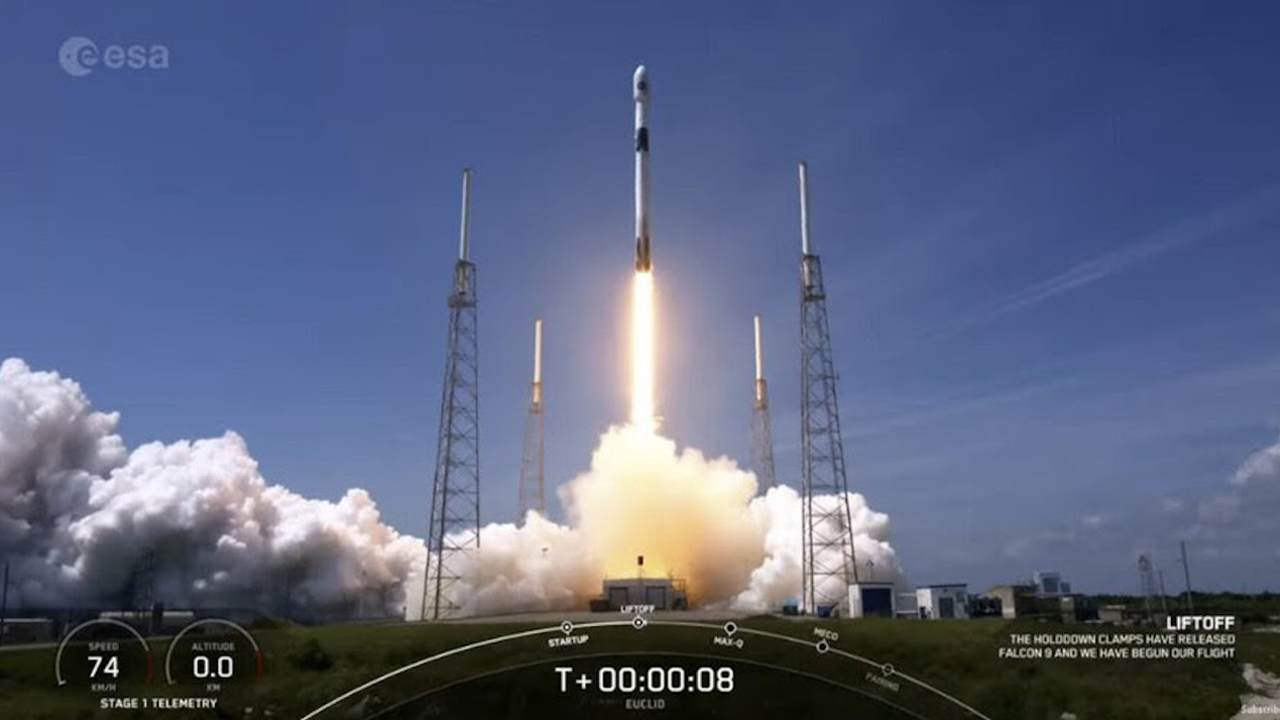

A Falcon 9 launches Europe’s Euclid space telescope on July 1, 2023.
Image credit: ESA webcast.
In addition to this week’s Launch Roundup, we thought we would look at how China’s leading launch provider is facing competition while SpaceX has consolidated its hold on the US market.
Chinese launchers

Launches: 31-0 (through July 27)
Launch Providers: 7
The government-owned China Aerospace Science and Technology Corporation (CASC) has long dominated the Chinese launch market with its Long March family of boosters. In recent years, however, the government has opened the door for commercial competition. Private and partly-private launch startups and a publicly-owned subsidiary to diversify the market.
The effort is beginning to bear fruit. CASC has conducted 22 of 31 Chinese launches through July 27. Six commercial companies have performed the other nine launches — 29 percent of the total.
Chinese Launch Vehicles Flown by Startups in 2023
(Excludes CASC’s Long March Launchers)
| Launch Vehicle | Stages | Payloads | Company | Company Type |
|---|---|---|---|---|
| Ceres 1 | 3 solid, 1 hydrazine | 400 kg (882 lb) LEO, 300 kg (661 lb) SSO | Galactic Energy | Private |
| Hyperbola 1 | 2 solid | 300 kg (661 lb) LEO | i-Space | Private (Motors procured from state-owned CASC*) |
| Kinetica 1 | 4 solid | 2,000 kg (4,409 lb) LEO, 1,500 kg (3,307 lb) SSO | CAS Space | Spun off from & partly owned by state-run Chinese Academy of Sciences |
| Kuaizhou-1 | 3 solid, 1 liquid | 430 kg (948 lb) SSO | ExPace | Subsidiary of state-owned CASIC+ |
| Tianlong-2 | 3 liquid | 2,000 kg (4,409 lb) LEO, 1,500 (3,307 lb) SSO | Space Pioneer | Private |
| Zhuque-2 | 2 liquid | 6,000 kg (13,228 lb) LEO, 4,000 kg (8,818 lb) SSO | LandSpace | Private |
+ China Aerospace Science and Industry Corporation
Source: Wikipedia
The Chinese government has been assisting some commercial companies under its military-civil fusion policy, which is designed to transfer technology and expertise to the private sector. For example, i-Space secured solid-rocket motors for its Hyperbola 1 from a subsidiary of CASC. It is believed that other startups have benefited from the transfer of military solid-rocket motors used in ballistic missiles.
Two Chinese companies achieved breakthroughs with liquid-fuel boosters this year. On April 2, Space Pioneer became the first Chinese startup to reach orbit with a liquid-fuel rocket on its maiden flight with the launch of the Tianlong-2 booster.
On July 12, LandSpace made history when it conducted the world’s first successful launch of a liquid methane-fueled rocket. The two-stage Zhuque-2 booster is fueled by liquid methane and liquid oxygen (methalox). LandSpace beat out American companies SpaceX, Blue Origin, and Relativity Space, which are also developing methane-fueled rocket engines.
US launchers

Launches: 57-4 (through July 27)
Launch Providers: 8 (7 active)
SpaceX utterly dominates the US market. The Elon Musk-led company has launched 48 Falcon 9 and two Falcon Heavy boosters. SpaceX’s only failure was the maiden flight of Starship/Super Heavy in April.
There are five reasons for SpaceX’s domination. One is price: The company has captured a large share of the domestic and international market for satellite launches of all sizes by undercutting the competition.
The second reason, in keeping with the first, is the eight Transporter rideshare missions that have launched 673 small payloads into orbit since January 2021 at low prices that most small-satellite launch providers can’t match.
The third reason is that SpaceX can rapidly reuse Falcon 9 and Falcon Heavy first stages and payload fairings. This is something no other company in the world can do. SpaceX has launched and landed first stages as many as 16 times.

The fourth reason is that SpaceX generates much of its own launch demand. Twenty-eight of the company’s 51 rocket launches have been dedicated to placing 1,216 Starlink broadband satellites into orbit.
Even subtracting the Starlink launches, SpaceX is still far ahead of its nearest American rival. Rocket Lab has launched its Electron rocket six times. The company has also conducted the maiden flight of its HASTE suborbital rocket, which is based on the Electron booster.
The 23 SpaceX not dedicated to Starlink also put the company one flight ahead of its nearest international rival, CASC.

The fifth reason for SpaceX’s dominance is that its main rivals are in a period of transition. United Launch Alliance (ULA), which has launched only once this year, is in the process of phasing out its Delta IV Heavy and Atlas V boosters in favor of the Vulcan Centaur rocket. The new booster has suffered years of delays; its maiden flight has been pushed back to late this year.
In Europe, Arianespace’s Ariane 5 rocket flew for the final time on July 5. Its replacement, Ariane 6, is also running years behind schedule with a maiden launch set for either late this year or early 2024.

Northrop Grumman is set to launch the current version of its Antares rocket for the final time on August 1. The company no longer has access to the Ukrainian-built first stages and the Russian engines that power it due to the war in Ukraine. Firefly Aerospace is producing an all-American stage with new engines to replace the existing one.
Antares has only launched Cygnus resupply vehicles to the International Space Station (ISS) for NASA. The rocket’s Russian-supplied engines made it difficult to get the rocket certified to carry military and national security payloads. The new US-manufactured first stage would remove that obstacle.
Northrop Grumman operates the Pegasus small-satellite booster and a family of Minotaur solid-fuel rockets. These launchers do not fly very often due to limited demand and relatively high prices. The Minotaur rockets are prohibited by law from competing with commercial launchers. They are largely confined to launching a small number of government payloads on an infrequent basis.

Firefly Aerospace has not yet launched this year. The company’s Alpha booster failed on its inaugural flight in 2021, and then experienced a partial failure last year when the booster deployed satellites at a lower-than-planned orbit. (Firefly considers the launch to be a success.) Firefly is tentatively scheduled to launch Alpha for the third time in August, following months of delays.
In addition to SpaceX’s Starship, three other small-satellite boosters – ABL Space Systems’ RS1, Relativity Space’s Terran 1, and Virgin Orbit’s LauncherOne – suffered launch failures this year.
Two of the three small satellite launchers will never fly again. Relativity Space decided to retire Terran 1 after its maiden flight in order to focus on developing the larger Terran R rocket. LauncherOne was retired from service after Virgin Orbit ceased operations.
